
Some common symptoms of the luteal phase are fatigue, physical discomfort, and mood swings. Physical discomfort is one thing, but mood swings? Those are no joke.
Usually, the first half of my cycle feels easy. I move through it with energy to spare.
But once I enter the “fall” and “winter” season of my cycle, things change. I often feel tired, easily irritated, more self-critical (and critical of others), and more sensitive overall.
For me, yoga, Ayurveda, and meditation make a world of difference—every day, but especially during the luteal phase.
And I’m not the only one. Research involving 128 women with one or more PMS symptoms showed that a daily yoga practice significantly reduced their symptoms during the luteal phase.
So, why not give it a try yourself? Below, you’ll find how yoga and Ayurveda can help you move through your cycle with a little more ease and calm.
Practice yoga with me offline at one of my Mini Retreats in The Hague on 19 and 26 July 2026!
What is the luteal phase?
The luteal phase begins after ovulation and lasts until your next period. In an average cycle, this is roughly from day 15 to day 28 (or until day 1 of your next cycle).
During this time, your body prepares for a possible pregnancy. If that doesn’t happen, your corpus luteum starts to break down. This is a group of cells that produces progesterone to get your uterus ready for an embryo, and it forms every month after ovulation.
What happens to your hormones during the luteal phase?
They’re on a bit of a rollercoaster.
Estrogen drops significantly after ovulation. There’s a slight rise afterward, but it doesn’t reach the same levels as in the first half of your cycle.
At the same time, progesterone rises and reaches its peak, before dropping sharply right before your period.
These hormonal shifts can affect how you feel—both physically and mentally.
What does Ayurveda say about the menstrual cycle?
According to Ayurveda—a traditional healing system from India that’s closely connected to yoga—different doshas dominate each phase of the cycle.
There are three doshas: vata, pitta, and kapha. In Ayurveda, these are used to understand and balance your physical, mental, and emotional health.
- Vata is made up of air and ether, and governs movement
- Pitta consists of fire and water, and governs transformation
- Kapha is made up of earth and water, and governs growth and structure
The four phases of the menstrual cycle
Your menstrual cycle consists of four phases: menstruation, the follicular phase, ovulation, and the luteal phase. You can think of them like the four seasons:
- Menstruation (winter)
- Follicular phase (spring)
- Ovulation (summer)
- Luteal phase (autumn)
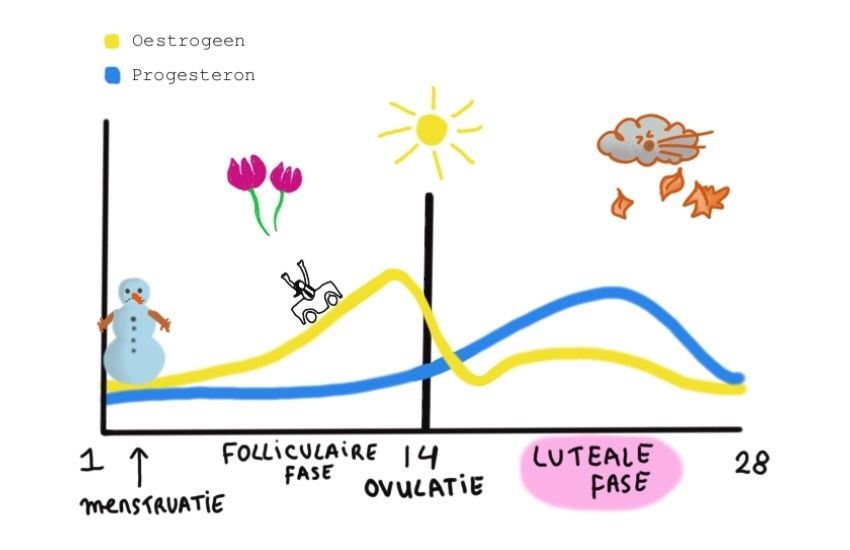
1. Menstruation (winter)
During your period, both estrogen and progesterone are low. In Ayurveda, vata is dominant, which means it’s a time to focus on grounding: warmth, rest, and routine.
Gentle practices are especially supportive now, such as restorative yoga, meditation, yin yoga, and calming pranayama (breathwork), like alternate nostril breathing (anulom vilom) or belly breathing.
If you experience a lot of pain during your period, very gentle yoga can help, especially practices that relax the psoas. On my YouTube channel, I share free yoga classes specifically for this.
I have adenomyosis, which means I experience significant pain on the first day of my period. These very soft, supportive poses make a big difference for me:
2. Follicular phase (spring)
During the follicular phase, your estrogen gradually rises as your body rebuilds toward ovulation. According to Ayurveda, kapha may still be present (the heaviness of winter), so it’s helpful to introduce light movement and gentle backbends.
This phase is like spring: you feel fresher, more inspired, and your energy starts to increase. In your yoga practice, you can begin with gentle vinyasa and slowly build it up.
3. Ovulation (summer)
In the summer phase—around ovulation—your estrogen peaks, and hormonally, you’re at your high point. Pitta is dominant (fire, intensity), making it a good time to be more active.
You may feel more extroverted, more outward-focused, and more connected. This is a great time for stronger vinyasa or even power yoga.
Just be mindful not to overheat, and include moments of mindfulness to keep your pitta in balance.
4. Luteal phase (autumn)
During the luteal phase, estrogen decreases while progesterone rises, then drops again just before your period. According to Ayurveda, vata increases as you move toward menstruation, so it’s again important to focus on rest and stability.
You can support your body during this phase by:
- Eating warm, nourishing foods (I love kitchari, a great Ayurvedic recipe for balance)
- Keeping a consistent daily rhythm
- Reducing stimulation (both physically and mentally)
- Prioritizing self-care (oil massages, rest, quiet moments)
This phase is like autumn—a time to turn inward. Practices like yin yoga with forward folds or slow, gentle flows work well here.
Give yourself more space to rest. Self-care becomes especially important, particularly if you’re sensitive to hormonal fluctuations.
Luteal phase: symptoms
Common symptoms during the luteal phase include:
- Mood swings
- Sensitive breasts
- Bloating
- Acne
- Changes in appetite
These are similar to PMS (premenstrual syndrome). Some people experience only mild symptoms, while others are more affected. It’s estimated that 80–90% of menstruating women experience at least one PMS symptom.
Physically, you might notice:
- Lower energy
- Headaches or pelvic pain
- Sleep disturbances
- End-of-day fatigue
- Bloating
- A slightly higher body temperature
Mentally and emotionally, you may experience:
- A stronger need for rest and solitude
- Increased irritability
- Difficulty concentrating
- Lower libido
- More overthinking, sadness, loneliness, or emotional sensitivity
For some, symptoms can be more intense due to PMDD (premenstrual dysphoric disorder).

PMDD (premenstrual dysphoric disorder)
With PMDD (premenstrual dysphoric disorder—a more severe form of PMS), these symptoms can feel much more intense because you’re more sensitive to the hormonal fluctuations in your body.
Physical PMDD symptoms
- Severe fatigue or exhaustion
- Bloating and water retention
- Headaches or migraines
- Painful breasts
- Cramps (sometimes even before your period starts)
Mental and emotional PMDD symptoms
- Irritability or sudden anger
- Intense mood swings
- Low mood or feelings of depression
- Anxiety or restlessness
- Emotions that feel heavy and overwhelming
Ayurvedic tips for PMS and PMDD
A slight dip in energy or a need for more rest is completely normal during the luteal phase.
But if you feel like Jekyll and Hyde every month, that’s not just a phase to push through. It’s your body telling you to slow down.
From an Ayurvedic perspective, PMS and PMDD are signs that one or more doshas are out of balance.
- Vata imbalance may show up as mood swings, anxiety, insomnia, and headaches
- Pitta imbalance may show up as irritability, anger, feeling overheated, and menstrual pain
- Kapha imbalance may show up as low mood, weight gain, and sluggishness
Restoring balance by reducing stress
The first step is to reduce stress hormones (cortisol) by creating more rest in your day.
When you experience long-term stress, elevated cortisol can lower progesterone levels, which may lead to estrogen dominance (a relative lack of progesterone compared to estrogen).
Cortisol levels are naturally already higher during the luteal phase. So if you add more stress on top of that, it can lead to increased irritability, a more reactive nervous system, and more intense luteal phase, PMS, or PMDD symptoms.
Things you can do to restore balance:
- Daily meditation and pranayama
- Consistent sleep and meal times
- Restorative yoga
- Yin yoga
- Legs up the wall (Viparita Karani)
- Warm, nourishing meals (soups, stews, grains)
- Regular eating patterns (don’t skip meals)
- Healthy fats (like ghee or olive oil)
- Staying well hydrated
- Abhyanga (self-massage with warm oil)
- Less screen time and stimulation in the evening
- Gentle walks in fresh air
Try this breathing exercise below to reduce anxiety and stress:
The best yoga during the luteal phase
The best yoga during the luteal phase is the kind that supports what your body needs. In general, this means slow, calming practices such as gentle vinyasa, yin yoga, or hatha yoga.
1. Yin yoga (foundation)
Yin yoga consists of poses that are held for a longer period of time (3–5 minutes). It targets the deeper connective tissues, such as fascia, ligaments, and joints.
There is very little muscular effort involved, but you stay present and aware in the stretch. It can sometimes feel challenging to stay in certain poses for longer, but the “trick” is to keep focusing on your exhale, allowing the body to gradually release more and more tension.
2. Restorative yoga (when you’re really tired)
Restorative yoga is focused entirely on deep relaxation and recovery. Most poses are supported with props such as cushions, bolsters, or blankets, so your body can fully let go.
There is no effort involved—the practice is as passive as possible. This helps calm the nervous system and reduce stress hormones.
Below you’ll find a restorative yoga class specially designed for people with endometriosis:
3. Slow flows
If you still have some energy, you can do gentle vinyasa or a slow flow. Keep the pace calm, with plenty of pauses (for example in Child’s Pose). The goal is to move without overstimulating your nervous system.
What your practice can look like
Keep it simple.
- Shorter sessions (15 minutes is enough)
- Focus on the breath (especially long exhales)
- No pressure to perform
The only goal is to feel calmer after your practice than before.
What to avoid
- Intense power yoga
- HIIT-style flows
- Lots of jumping or fast transitions
- Pushing through when you’re already tired
When you do a lot of “yang” (active) exercise or intense movement, you can overstimulate your nervous system, especially if you don’t follow it with enough rest.
Conclusion: your cycle tells you what you need
Your cycle is a messenger. It shows you when you can build, when you can go full energy, and when you need to slow down.
When you experience intense symptoms during your luteal phase, or struggle with PMS or PMDD, these are strong signals that your body is asking for more balance and rest.
This doesn’t mean you need to quit your job or take a sabbatical. If that’s possible, great. But even just ten minutes of daily meditation or yoga can already make a big difference.

Yoga teacher (CYT200+) with additional training in Ayurveda and holistic health for women | Author of Out of the Mud: A Holistic Approach to Healing | MSc | Indo Roots | Blogger | Founder Wildheart Surf ~ Women’s Retreats