
Yoga for surfers focuses on improving flexibility and building the specific strength you need in the water.
At the same time, it helps develop your endurance. Exactly what surfing demands: strength, flexibility, and stamina.
Below, you’ll find a number of yoga exercises for surfers that I practice regularly and include in my yoga classes.
I’ve also added a calming breathing exercise to help you stay relaxed in more chaotic situations, like a rough sea or when you accidentally get caught in a rip current (always fun).
Yoga for surfers: exercises for strength, flexibility, and endurance
Yoga for more strength and balance while surfing
In my yoga class below (in English—with a nice Dutch accent), you’ll work on your core for a strong pop-up:
The first thing you’ll want to work on is strengthening your paddle and pop-up muscles—your arms, shoulders, lats, as well as your core and legs.
These are the main muscle groups you use while surfing:
- For paddling: deltoids, triceps, biceps, trapezius, chest muscles, lats (latissimus dorsi), and rhomboids.
- For balance while lying on your board: your core (abdominals) and lower back muscles (erector spinae).
- For the pop-up: chest, core, psoas, arms—pretty much everything.
- For standing and surfing: quadriceps, glutes, hamstrings, and calves.
- For balance while standing on your board: ankle and foot muscles.
But in reality, you need almost every muscle in your body to surf.
What I love about yoga is that you can use it for everything: building strength, supporting recovery, and also training your mindset and control over your breath.
Yoga to improve flexibility in your back and shoulders
Below, you’ll find a yoga session focused on increasing flexibility in your shoulders and back:
As you’ve probably already noticed, a lot of surfing can leave your body feeling extremely stiff. Not only is that uncomfortable, it also affects your performance—because the stiffer your body, the harder your pop-up becomes.
What you’ll want to focus on is keeping these areas flexible:
- Hips (for a fast pop-up)
- Chest and shoulders (to counter the paddling position)
- Spine (for rotation, essential for turns)
By combining power yoga with slower or restorative yoga, you’ll improve both strength and flexibility. This gives you more freedom of movement overall.
Note: are you naturally very flexible? Then there’s a good chance you tend to “hang” in your joints rather than actively using your muscles.
In the water, that can lead to less control during your pop-up, instability in your shoulders, and a higher risk of injury.
In that case, don’t push to your maximum range. Instead, work at about 70–80% of your mobility. You don’t need more stretch—you need to build strength and control.
A few extra tips:
- Don’t lock your elbows in high plank—keep a slight bend.
- Avoid locking your knees in poses like Tadasana (Mountain Pose).
- Focus more on activating your muscles than on increasing your range of motion.
Read more about hypermobility.
Yoga for better stamina
In this flow, you’ll build up your stamina for longer surfing sessions:
Most surfers spend long periods in the water, paddle constantly, and need to deliver short bursts of explosive energy from time to time.
That requires solid endurance. An active vinyasa yoga practice can really help with that.
It builds your stamina through continuous flows, and by teaching you to become more aware of your breath. This leads to more efficient use of your energy.
You learn to stay relaxed under effort—which comes in handy when you’re already tired but still want to catch that one last wave.
4:8 breathing exercise to stay calm
Use this breathing exercise to stay calm in chaotic situations:
While surfing, I’ve often found myself in situations that weren’t exactly comfortable, even after years in the water.
Rip currents, big sets, long hold-downs, chaotic line-ups, angry Brazilians… you go through a lot as a surfer.
And the most important thing in those moments is to stay calm. Easier said than done sometimes, but breathing exercises can help tremendously.
Of course, you want one that’s calming, simple, and easy to remember. For me, that’s the 4:8 breathing technique: inhale for four counts, exhale for eight.
By making your exhale longer than your inhale, you activate your parasympathetic nervous system—your rest-and-digest mode. This helps slow your heart rate, reduce stress, and stay focused (instead of panicking).
When and how to stretch before and after surfing?
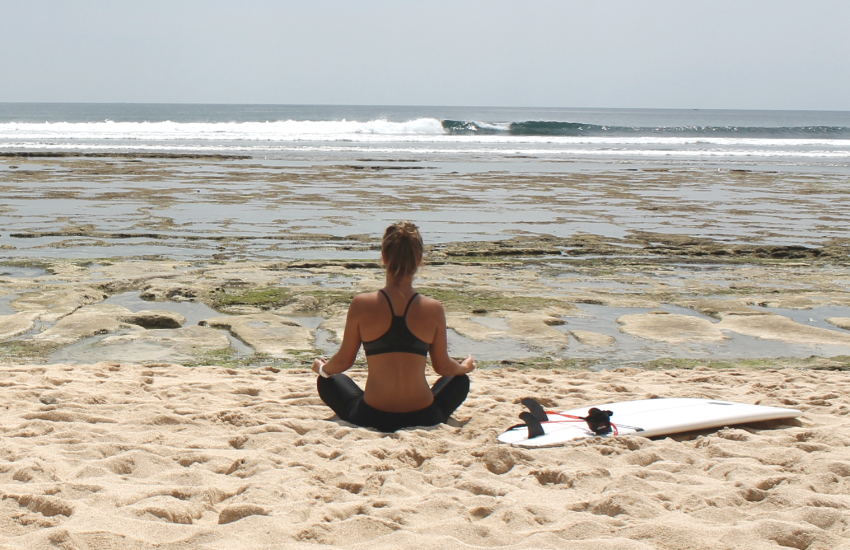
If you’re young or just starting out as a surfer, you probably think doing a warm-up before surfing is a bit pointless. You’d rather jump straight into the water, right?
Still, you’ll benefit much more from taking a few minutes to warm up your muscles and get your heart rate up first. It makes your joints and muscles more flexible, allowing you to move better in the water. So this benefits you right away.
On top of that—and this is especially true for slightly older surfers—you’re more likely to get injured if you skip a warm-up. You’ll be using muscles that you probably don’t activate as much in everyday life.
There are even more reasons to warm up: you prepare your heart, get your body ready for the cold water, generate more energy, and can last longer in the water.
Yoga is a great way to warm up your body before surfing. And after your session, it provides a deep, satisfying stretch. Here’s the best way to use yoga for surfers:
- Yoga before surfing: dynamic (to warm up your body and prepare your muscles)
- Yoga after surfing: longer holds (in a calm, pain-free way, focused on recovery and relaxation)
Practice yoga for surfers together, offline
It’s obviously much more fun to do it together, in real life. So if you’d like to combine yoga with improving your surf skills:
- Check out my surf and yoga retreats in Spain
- Or join a surf and yoga day in The Hague on July 19 and 26, 2026!

Yoga teacher (CYT200+) with additional training in Ayurveda and holistic health for women | Author of Out of the Mud: A Holistic Approach to Healing | MSc | Indo Roots | Blogger | Founder Wildheart Surf ~ Women’s Retreats